law-bench: Making Contract-Drafting Quality Measurable, Iterable and Regression-Testable
An evaluation loop for Chinese contract drafting: all-pass binary aggregation instead of weighted scoring, with multi-judge per-criterion verdicts driving clause-level self-healing. 39 of 43 contract types reach all-criteria pass (18/19 typical, 21/24 atypical). We also report a negative result honestly — a human blind-labelling pilot measured only 36.5% human-judge agreement (κ=0.075), with judges systematically stricter than humans, so that pass rate is an internal scale, not a human-validated accuracy.
Bottom line first
We built an evaluation loop for Chinese contract drafting. Its core is not “more accurate scoring” but that it changes what the generator can do: collapsing per-criterion verdicts to a binary all-pass signal removes the trade-off between criteria, so the generator can no longer offset a missing mandatory clause with strengths elsewhere, and the only way to move the signal is to fix each point.
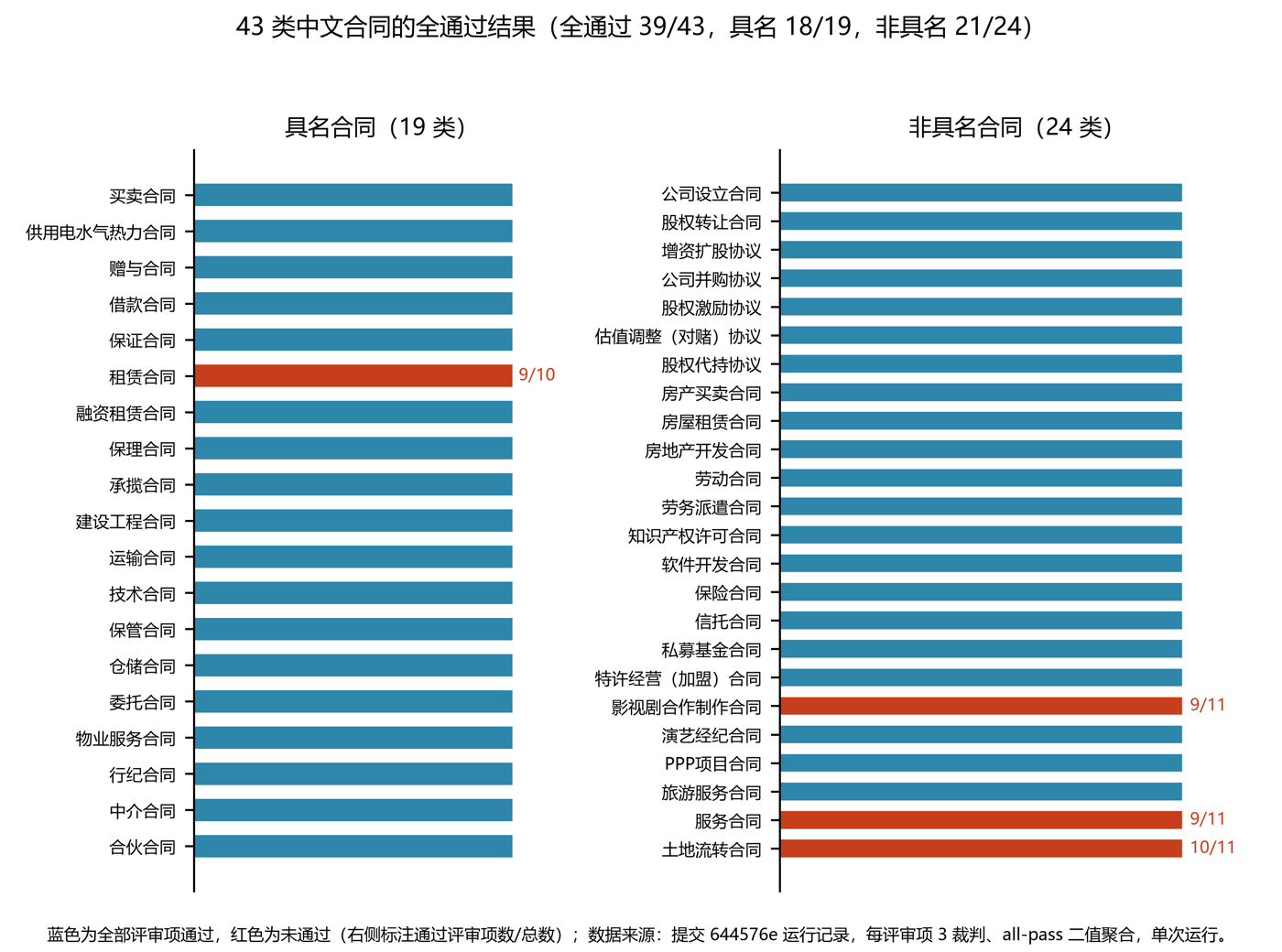
On 43 Chinese contract types — the typical contracts of the Civil Code plus common atypical ones — 39 types reach all-criteria pass (18/19 typical, 21/24 atypical). The four failing types each miss only one or two criteria, and they split into two structurally different kinds: a defect in the clause itself, and a ceiling on the judge’s own reliability.
One thing must be said in the same breath: we ran a human blind-labelling pilot to test the judges, and the result is negative — over 126 contract-criterion pairs, inter-annotator agreement was 85.7% (κ=0.522), while human-judge agreement was only 36.5% (κ=0.075), and the disagreement is strongly one-directional (humans pass where judges fail in 157 cases; the reverse in 3). This means 39/43 must be read as consistency under the system’s internal scale, not as human-validated accuracy. The result does not overturn the method’s usefulness, but it fixes how it may be read: the judge signal is good enough to decide when the self-healing loop stops, not good enough to serve as ground truth, and human review must stay inside the loop.
Method and conditions
Why not weighted sums. Weighted scoring turns criteria into mutually compensable components; the loss from one missing mandatory clause can be recovered from surplus elsewhere, so the generator can route around a single legal requirement and still move the total. Binary aggregation removes that trade-off: the signal answers only “is there an unmet normative requirement”. The cost is that binary alone does not rank quality (9/10 and 0/10 are both 0), so the diagnostic role goes to the pass count — which criterion is stuck, whether a rewrite moved it, all answered by the per-criterion record.
Multiple judges and confidence. Each criterion is ruled on independently by three judge models; the majority forms the verdict, and the share of judges supporting it is the confidence. Multi-judge is aimed at measurable judge bias and at performance differences between judges large enough to change conclusions; a single judge’s taste is not a quality criterion.
How self-healing writes back. Improvement is triggered by a confidence threshold, and the threshold is a simple majority rather than unanimity — a unanimous threshold leaves real defects in place whenever two judges fail a clause and one passes it. Write-back merges rather than replaces: update the body if a custom clause exists, create one if not, because a full rewrite loses what earlier rounds already got right while fixing one defect.
Evaluation set. 43 Chinese contract types (19 typical Civil Code contracts + 24 atypical), with a further 23 not entering evaluation; every count-based claim uses 43 as the denominator. Each type is evaluated against its own rule set (8–11 criteria). There is no train/test split.
Result caliber. Data come from a single run record (commit 644576e). The self-healing process contains multiple rounds, but the full evaluation was not re-run, so no mean or standard deviation is reported.
Results
Main result. 39 of 43 types pass every criterion. By group: 18/19 typical (95%), 21/24 atypical (88%). Most types reach all-pass within the first two rounds.
Threshold sensitivity. A unanimous threshold (0.99) reacts only to unanimous failure, so 8 types stall on the judges’ split floor: two of three judges find a real defect (confidence 0.67) and the third passes, giving only partial pass with no improvement triggered. Lowering the threshold to a majority (0.67) unlocks all 8 within one to two rounds. The problem with unanimity is that it ties sensitivity to whichever judge is most lenient.
Two kinds of structural wall.
| Type | Symptom | Attribution | Direction |
|---|---|---|---|
| Lease | Stuck on a single criterion (accuracy of statutory citation); 5 rounds of rewriting never satisfied all 3 judges | Clause-quality wall | The generator cannot substantiate the citation it makes; the fix is retrieval and verification of statutory basis |
| Land transfer / film production / service | Appears as 0.67-confidence majority disagreement; improvement triggers but does not converge within the round cap, and the pass count oscillates | Judge-reliability ceiling | Existing records support only that these are undecidable under the current judge set, not that the clauses are defective |
Conflating the two misleads in both directions: treating measurement noise as a quality defect leads to pointless corpus rewriting, while attributing a real defect to the judge shelves a generator capability gap as a tooling problem.
Judge-validity pilot (a negative result — the honest core of this section). From all evaluation runs carrying complete drafts, three (draft × criterion) pairs were drawn per contract type, stratified, giving 126 pairs (42 of the 43 types have draft-bearing runs), with two blind labelling slots:
- Inter-annotator agreement 85.7% (126 double-labelled pairs, κ=0.522, moderate);
- Human-judge agreement 36.5% (κ=0.075);
- Confusion matrix (252 verdicts): human pass / judge fail in 157 cases, human fail / judge pass in 3 — the disagreement is strongly one-directional, with judges systematically stricter than humans.
An engineering constraint that changes how results must be read. A first attempt at 36-way concurrency (4 evaluation streams × 3 judges × 3 workers) produced 0/10 for the property-service contract. Investigation confirmed this was not contract quality but a rate-limit cascade: requests over the upstream quota returned 429, and recording a 429 as a failure turns a contract missing one or two criteria into a zero-pass contract. At 12-way concurrency no 429s occurred. The cause is that limiting is metered per account, not per model — the three judge backends share one bucket. Since 0/10 and 9/10 are both 0 under all-pass aggregation, one cascade amplifies noise into a signal indistinguishable from a structural defect, so any pass-rate figure must state its concurrency configuration.
What it means in practice
For people building evaluation systems: binary aggregation is not an accuracy compromise but a redefinition of the objective. If, in your setting, “one missing mandatory item” cannot be offset by “everything else done well”, then a weighted score is the wrong measure. Conversely, if you need quality tiers rather than compliance verdicts, binary throws away information you need.
For people using LLMs as judges: the number our pilot produced is 36.5% agreement — far worse-looking than most published figures. The reason is not a weak model, but that we placed the judge inside a strict binary decision with no alignment calibration. Anyone wiring a judge signal into an automated pipeline should first run a blind pilot like this, measure their own number, and then decide whether the judge can be a stopping signal and whether it can be ground truth.
How we use it: the judge only decides when the self-healing loop stops, never serves as ground truth, and human review stays inside the loop. That is the part of our own system this negative result changed.
Three things still owed (listed as limitations in the paper): (1) the gains from self-healing and from tagging were not ablated, so their contributions can only be inferred indirectly from per-criterion records; (2) the evaluation ran once, with no mean or standard deviation, and the passing list holds only for this concurrency configuration; (3) the evaluation set covers Chinese law only — extending it requires rebuilding the mandatory-requirement list and criteria for the target jurisdiction, so the method transfers but the content must be rebuilt.